How to choose a web design agency
A practical guide to choosing a web design agency based on strategy, process, technical quality, communication, CMS structure and long-term fit.
June 11, 2026
Choosing a web design agency is not just a matter of comparing portfolios and prices.
You are choosing the team that will translate your business, positioning, content and goals into a website your company may depend on for years.
A visually impressive portfolio matters. So do testimonials and relevant experience. But those things alone do not tell you whether an agency will make good decisions when the brief is incomplete, whether the website will remain manageable after launch, or whether the team will simply build exactly what you asked for without questioning whether it makes sense.
The best way to choose a web design agency is to evaluate how they think, not only what they have already designed.
These are the nine things we would look at before hiring one.
1. Look for an agency that challenges the brief
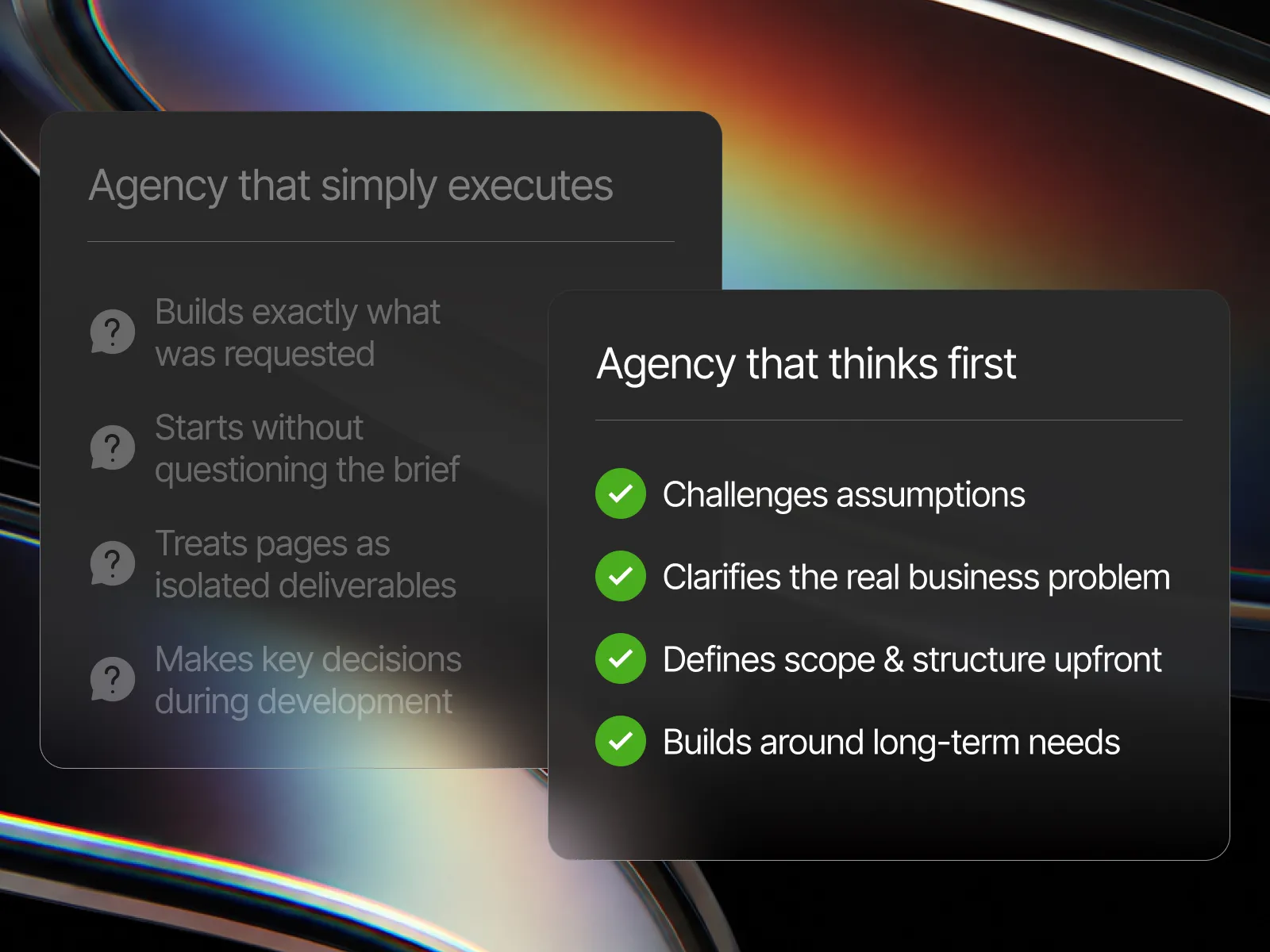
This is one of the biggest differences between an executor and a real website partner.
Clients do not always need exactly what they initially ask for.
You might approach an agency asking for:
- A complete website redesign.
- Ten new landing pages.
- A complex animation.
- A large CMS system.
- A particular platform or technology.
Sometimes that is exactly the right solution. Sometimes it is not.
A good agency should first understand why you are requesting it.
If a simpler solution can achieve the same objective, they should tell you. If the proposed structure is likely to create problems later, they should explain why. If a feature adds complexity without meaningful value, they should be comfortable recommending against it.
You are hiring specialists partly because they should see risks, trade-offs and opportunities that are difficult to identify from inside the business.
An agency that agrees with every request may feel easy to work with at the beginning. It can become expensive later.
2. See whether they understand the business before discussing visuals
A website is not an isolated design exercise.
Before making significant design decisions, the agency should understand:
- Who the website is for.
- What the company sells.
- How visitors become customers.
- Which pages matter most.
- What the marketing team needs to manage.
- What the website may need to support in the future.
This does not require weeks of strategy workshops for every project. It requires asking the right questions before making major decisions.
A SaaS company publishing resources every week needs a different architecture from a company with five relatively static service pages. A company running frequent campaigns may need reusable landing-page components. A business publishing dozens of case studies may need a structured CMS rather than manually maintained pages.
The design should follow those requirements, not the other way around.
This is also why our website design service starts with structure, content hierarchy and the user journey rather than treating visual styling as the first decision.
3. Evaluate live websites, not just portfolio screenshots
A polished homepage screenshot tells you something about an agency's visual ability. It tells you much less about the finished website.
Open several projects from their portfolio and actually use them.
Check:
- Desktop and mobile layouts.
- Navigation.
- Page consistency.
- Loading behavior.
- Interactions.
- CMS-driven pages.
- Forms.
- Responsive details.
Look beyond the homepage too.
Many websites look impressive in the first viewport but become inconsistent across service pages, articles, case studies and mobile layouts.
The quality of the complete system is more important than one perfect hero section.
Our selected projects show full website implementations rather than only isolated design shots.
4. Understand how the agency approaches website architecture
This becomes increasingly important as a website grows.
There is a major difference between building 20 individual pages and building a system capable of supporting those pages efficiently.
Before hiring an agency, understand how they think about:
- Reusable components.
- CMS collections.
- Shared styles.
- Page templates.
- Naming conventions.
- Responsive behavior.
- Future sections and pages.
A poorly structured website can still look excellent when it launches. The problems appear later when the marketing team wants to add a landing page, update several sections, publish new content or change something globally.
For Webflow projects, this is especially visible because the platform gives teams a lot of control after launch. That control is useful only when the project has been structured deliberately.
Our Webflow development work focuses on reusable components, CMS logic, clean class structure, responsive implementation and a maintainable handoff rather than treating every page as an isolated build.
5. Ask who will be able to manage the website after launch
This question is often ignored until the website is finished.
Ask the agency: what happens when our marketing team needs to update the site?
For most business websites, changing a testimonial, publishing an article, adding a case study, updating a team member or editing standard content should not require a developer.
The implementation should make routine changes safe and understandable.
That does not mean your marketing team needs to learn HTML, CSS or advanced Webflow development. The goal should be the opposite.
A well-built system should expose the things the team needs to control while protecting the underlying structure.
Developers should still handle genuinely structural changes. Content teams should not need them for every small edit.
6. Check the agency's technical standards
Design is only one layer of the finished website.
The agency should also be able to explain how it handles:
- Responsive development.
- Performance.
- Technical SEO.
- Semantic structure.
- Image optimization.
- Redirects.
- CMS architecture.
- Analytics.
- Forms and integrations.
- Browser testing.
- Quality assurance.
You do not need to become a developer to evaluate this.
Pay attention to how clearly the agency explains these decisions. Statements such as "SEO optimized", "fast" or "fully responsive" mean little without an actual process behind them.
Ask what is included and how it is tested.
Technical quality should be considered during the build, rather than treated as a cleanup task immediately before launch.
7. Understand their process before signing
A strong portfolio cannot compensate for a chaotic project.
Before choosing an agency, understand the main stages between kickoff and launch.
For a full website project, that may include:
- Discovery and requirements.
- Website structure.
- Wireframes.
- Visual design.
- Development.
- CMS and integrations.
- Responsive implementation.
- QA.
- Launch.
- Handoff and support.
The exact process depends on the project. What matters is that responsibilities and approval points are clear.
You should know when content is required, when feedback is expected, how revisions work, what needs approval before development begins and what happens when the scope changes.
Many expensive development problems actually begin much earlier. An unclear page structure, unfinished content or major design changes after development starts can create considerably more work than resolving those questions beforehand.
Our full website service connects strategy, structure, design, Webflow development, SEO setup, QA and handoff as one process rather than treating them as disconnected tasks.
8. Look for evidence of communication and long-term reliability
Website projects involve many small decisions. Communication quality therefore matters almost as much as technical ability.
Look at client feedback and case studies for evidence of:
- Clear communication.
- Meeting deadlines.
- Responsiveness.
- Handling feedback.
- Solving unexpected problems.
- Continued collaboration after launch.
Long-term relationships can be particularly useful evidence because they show that the agency remained valuable after the initial project was delivered.
Our work with Transcenda, for example, developed from ongoing website support into a long-term partnership that included continuous optimization, expansion and eventually a full redesign and rebuild.
The Transcenda case study shows how that relationship developed beyond a one-off delivery.
9. Compare value and scope, not only the final price
Three agencies can quote three very different prices for what appears to be the same website.
Often, they are not actually quoting the same work.
One proposal might include:
- Website strategy.
- UX and information architecture.
- Custom design.
- Responsive design.
- Webflow development.
- CMS setup.
- Animations.
- Technical SEO.
- Migration.
- QA.
- Launch support.
Another may cover only design and basic development.
Before comparing numbers, normalize the scope.
Check what is included, what is excluded, how revisions work, who provides content, whether migration is included, what happens after launch and how additional requests are priced.
The cheapest proposal can be the correct choice for a simple project. The most expensive proposal is not automatically the best either.
The important question is whether the proposed solution matches the actual problem.
Questions to ask a web design agency before hiring them
You can simplify much of the evaluation process by asking these questions during the first conversations:
- What would you need to understand before recommending a solution?
- Do you see any problems with our current brief or proposed structure?
- Who will actually work on the project?
- How do you structure websites so they can scale?
- What will our marketing team be able to edit independently?
- How do you approach responsive development and QA?
- What technical SEO work is included?
- How are scope changes and revisions handled?
- What happens after launch?
- Can we see relevant live projects rather than only screenshots?
The answers matter, but so does how the agency responds.
A team that can explain trade-offs clearly before you become a client is more likely to do the same when difficult decisions appear during the project.
Our project FAQ covers the same practical areas from our side, including project fit, scope, revisions, timelines, ownership, hosting and support.
Red flags when choosing a web design agency
No single warning sign automatically makes an agency unsuitable, but several together should make you investigate further.
Be cautious when an agency:
- Recommends a solution before understanding the problem.
- Agrees with every request without asking why.
- Cannot explain its development process.
- Shows only static designs instead of live projects.
- Makes important structural decisions only after development has started.
- Cannot explain how the CMS will work.
- Treats mobile responsiveness as an afterthought.
- Is vague about ownership and handoff.
- Provides a price without clearly defining scope.
- Focuses almost entirely on visual design.
The fundamental problem behind most of these is the same: you are buying execution without enough thinking behind it.
The right agency should make the project clearer
A good web design agency should gradually remove uncertainty from the project.
By the time development begins, the team should have a clear understanding of the website's structure, content requirements, visual direction, CMS logic, functionality and technical requirements.
That clarity is part of the service.
The goal is not simply to find people capable of building a website that looks good on launch day. It is to find a partner capable of making good decisions with you and building a website that remains useful as the company evolves.
Review our recent work to see how we approach different website systems, or send us your project requirements when you are ready to define the right scope.